Tree Health Care
Why would a tree need Tree Health Care?
Tree Health Care is similar to health care provided to humans and other living things. Trees are living organisms and can get a weakened immune system.
Tree Health Care encompasses all aspects that help keep a tree healthy by managing stress, disease and insects in sick trees.
Trees in an urban environment are more stressed and are more prone to health problems because of several environmental factors. Trees in North Texas have region specific issues and patterns of health problem. A single tree planted in a yard does not have the same nutrient rich soil from a layer of decomposing leaf debris as forest trees do.
Having an Arborist who understands the complex ways soil and tree species interact, can determine specific needs and care of your tree to ensure the long-term health of your tree.
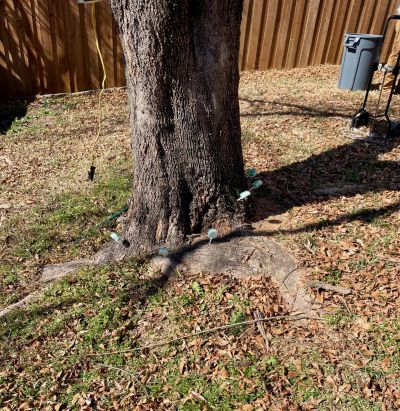
Common examples of environmental stress are soil compaction, changes in drainage, soil fill over the root system, mechanical damage to roots from construction, and excess salt accumulation. These stress factors alone, or collectively, reduce growth and may cause dieback.
Sidewalks, roadways, and building foundations may also restrict root growth and subject the tree to further stress. Shade and ornamental trees and shrubs are especially vulnerable to “people pressure” problems and other adverse environmental conditions because they are often planted in locations unfavorable for optimum growth.
Health problems to look out for
Mushrooms
Lack of Growth
Lack of Growth

Mushrooms indicate that some form of decay or decomposition is taking place. Fungi are in most instances, decomposing wood tissue, compromising the structural integrity of the tree.
Lack of Growth
Lack of Growth
Lack of Growth
Trees rely on healthy soil for vital nutrients and water, which are essential for growth, development, and survival. Poor soil health can stunt growth, make trees more susceptible to diseases and pests, and affect their overall lifespan.
Yellow Leaves
Root Disruption
Root Disruption
If you look at your tree during spring and summer and you notice the leaves aren’t a bright shade of green but instead yellowish or light green your tree might be telling you something is not right. When you see yellow leaves on a tree it often means there is a deficiency in chlorophyll.
Root Disruption
Root Disruption
Root Disruption
A healthy tree can sustain some root damage, but a tree under stress, like one living in a city and not in forest, can not sustain this type of stress for long because this is most likely not the only stressor the tree is enduring. Often we see trees die years later from root disturbance after they have used up all of its stored nutrients.